
Deep Dive
Architecture
The complete system architecture of the Land code editor - process model, inter-component communication patterns, component responsibilities, and the layered design that enables multi-process operation on macOS, Windows, and Linux.
Land System Architecture
The complete system architecture of the Land code editor. It covers the process model, inter-component communication patterns, component responsibilities, and the layered design that enables multi-process operation on macOS, Windows, and Linux.
Table of Contents
- Process Model
- Component Map
- IPC Architecture
- Service Layer Design
- Tier-Gated Implementation
- Data Flow Patterns
- Related Documentation
Process Model 🏗️
Land operates as a multi-process application with three concurrent processes:
| Process | Element | Language | Purpose |
|---|---|---|---|
| Native Backend | Mountain | Rust (Tauri) | Application lifecycle, OS operations, gRPC server, sidecar orchestration |
| Extension Host | Cocoon | TypeScript (Node.js) | VS Code extension execution, vscode API shim |
| UI Renderer | Wind + Sky | TypeScript (WebView) | Editor UI rendering, workbench services, Astro page composition |
A fourth optional process, the background daemon (Air), runs as a persistent sidecar for updates and indexing.
TierIPC note: The
TierIPCenvironment variable controls whetherWind/Outputroute IPC throughMountain(default), fall back toCocoonon miss (NodeDeferred), or bypassMountainentirely (Node). Per-subsystem overrides (TierTerminal,TierSCM,TierAuth, etc.) allow independent routing per channel. See EnvironmentVariables.md.

Component Map 🗺️
Rust Components (Native)
| Component | Crate Type | Role |
|---|---|---|
| Common | Library | Abstract trait definitions, ActionEffect system, DTOs, error types. Foundation layer with zero concrete implementations. All service interfaces (IFileService, IConfigurationService, etc.) are defined here as async traits. |
| Echo | Library | Bounded work-stealing task scheduler. Implements priority-based scheduling (High/Normal/Low) with lock-free deques (crossbeam-deque). Core execution engine for Mountain’s async workloads. |
| Mountain | Binary (Tauri) | Primary native application. Implements every trait from Common. Hosts the gRPC server (Vine protocol), manages AppState, dispatches Tauri commands, orchestrates sidecar lifecycle, owns OS-level capabilities (file system, terminal PTY, clipboard, dialogs). |
| Mist | Library + Binary | Local DNS server for *.editor.land resolution. Authoritative DNS for the private zone; resolves all subdomains to 127.0.0.1. Implements forward allowlisting for controlled external domain access. Used by Mountain and Air for network isolation. |
| Air | Binary | Background daemon. Runs as a persistent sidecar managed by Mountain. Handles: update downloads and verification, file indexing and search, cryptographic signing and authentication, background asset downloading, health monitoring, metrics collection. Communicates via gRPC on port 50053. |
| Rest | Binary + Library | High-performance TypeScript compiler built on OXC (Oxidation Compiler). Replaces esbuild’s TypeScript loader with a Rust-powered OXC pipeline, producing VS Code-compatible output at 2-3x speed improvement. Handles decorators, class field transformations, JSX. |
| Grove | Library + Binary | Native Rust/WASM extension host. Provides a sandboxed environment via WASMtime for running WASM-compiled VS Code extensions. Shares the same VS Code API surface as Cocoon. Supports gRPC, IPC, and WASM host function transport strategies. |
| SideCar | Library | Vendored runtime binary management. Packages exact Node.js binaries per target triple (aarch64/x86_64 for macOS/Linux/Windows). Provides download, caching, version resolution, and Git LFS management. Consumed at Mountain build time. |
| Vine | Protocol Library | gRPC protocol definitions for all inter-process communication. Defines Vine.proto - the service contracts used between Mountain (port 50051) and Cocoon (port 50052), and between Mountain and Air (port 50053). Generated stubs are consumed by every element that speaks gRPC. |
TypeScript Components (Web / Node.js)
| Component | Framework | Role |
|---|---|---|
| Cocoon | Node.js + ESBuild | Node.js extension host sidecar. Runs VS Code extensions in a supervised process. Provides a vscode API shim that translates extension calls to gRPC requests for Mountain or handles them in-process. Bootstrap is lean async (no Effect-TS runtime); stages run in a fixed order: RPCServer (port 50052) binds before MountainConnection so Mountain’s 30-second gRPC budget does not expire before Cocoon is ready. Extension dependencies are activated in topological order with a cycle guard. |
| Wind | Effect-TS + Vite | UI service layer that recreates the VS Code workbench environment inside a Tauri WebView. Implements ~40 effect services (IPC, Configuration, Editor, Terminal, Clipboard, Dialog, FileSystem, Window) composed into three Layer stacks: TauriLiveLayer, ElectronLiveLayer, TestLayer. Services use Layer.succeed (not Layer.effect) and are composed with Layer.mergeAll. The TauriLiveLayer is backed by an eager ManagedRuntime (module singleton via globalThis.__CEL_WIND_RUNTIME__) for sub-5ms service lookup. |
| Sky | Astro + Vite | UI component layer. Renders the editor interface (editor, sidebar, activity bar, status bar, panels) using Astro pages. Loads the VS Code workbench from @codeeditorland/output and bridges Tauri events through SkyBridge (~2900 lines). |
| Output | ESBuild | Build artifact management. Handles compilation of VS Code platform source via dual-compiler support (esbuild primary, Rest OXC optional). Produces the @codeeditorland/output npm package consumed by Cocoon, Sky, and Wind. |
| Worker | ESBuild | Service worker implementation. Provides asset caching (network-first for navigation, cache-first for static assets), offline support, and dynamic CSS loading. Intercepts JS imports of CSS files and responds with JS modules that trigger <link> tag injection. |
IPC Architecture 🔌
Inter-Process Communication Matrix
| Source | Sink | Protocol | Transport | Port |
|---|---|---|---|---|
Mountain | Cocoon | gRPC (Vine.proto) | TCP (localhost) | 50052 |
Cocoon | Mountain | gRPC (Vine.proto) | TCP (localhost) | 50051 |
Mountain | Air | gRPC | TCP (localhost) | 50053 |
Wind/Sky | Mountain | Tauri Commands | IPC (in-process) | N/A |
Mountain | Wind/Sky | Tauri Events | IPC (in-process) | N/A |
Cocoon extensions | Mountain | gRPC (via Cocoon) | TCP (localhost) | 50051 |
Request Flow for UI Operations
All requests from the user interface follow a consistent flow through the system:
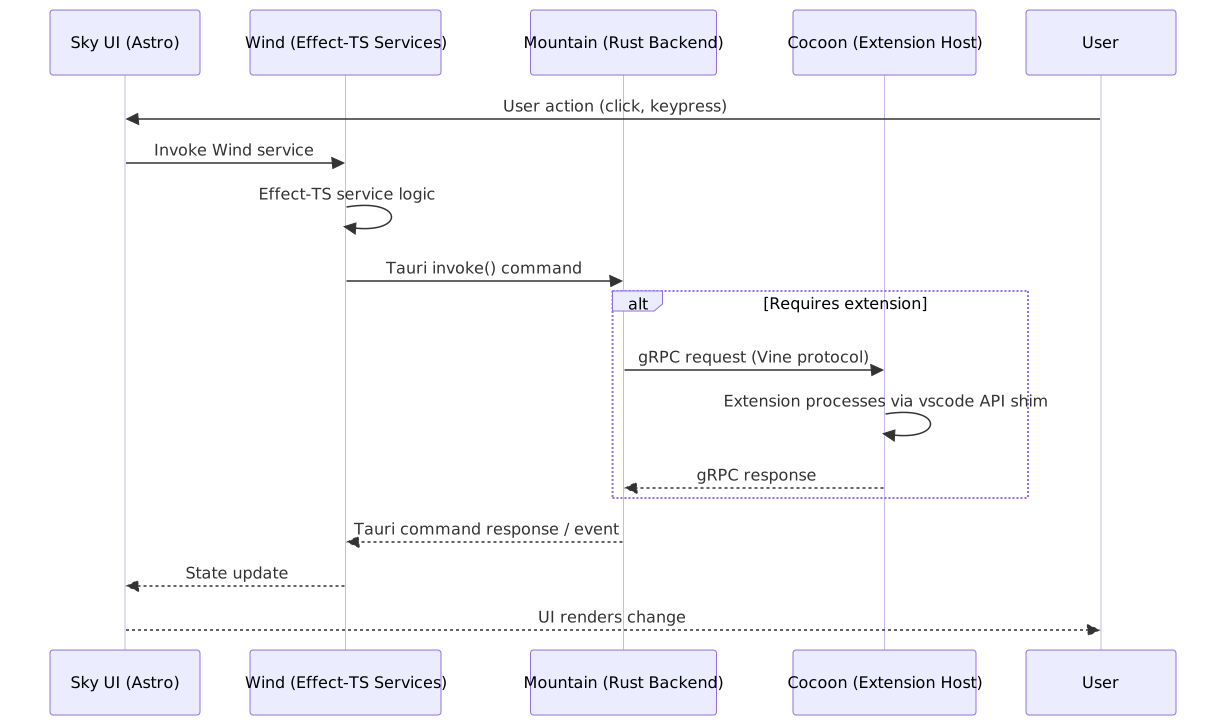
Protocol Layers
Land’s IPC uses three distinct protocol layers:
TauriCommands (request-response):WindinvokesMountainhandlers through@tauri-apps/apiinvoke(). Each command maps to a registeredRusthandler inMountain.- Used for: file read/write, configuration get/set, dialog open, terminal operations
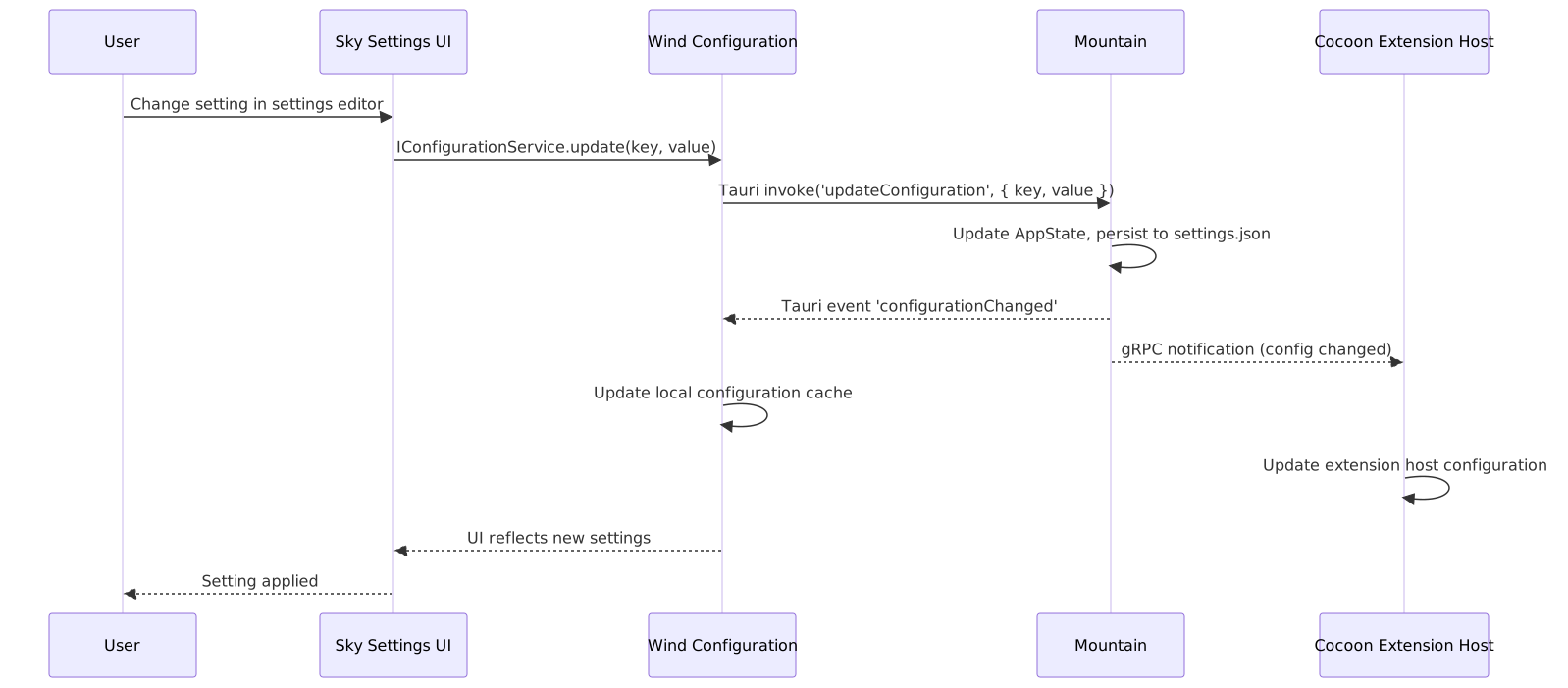
TauriEvents (push from Mountain):Mountainemits events thatWindlistens to.- Used for: configuration change notifications, extension activation signals, terminal output streaming
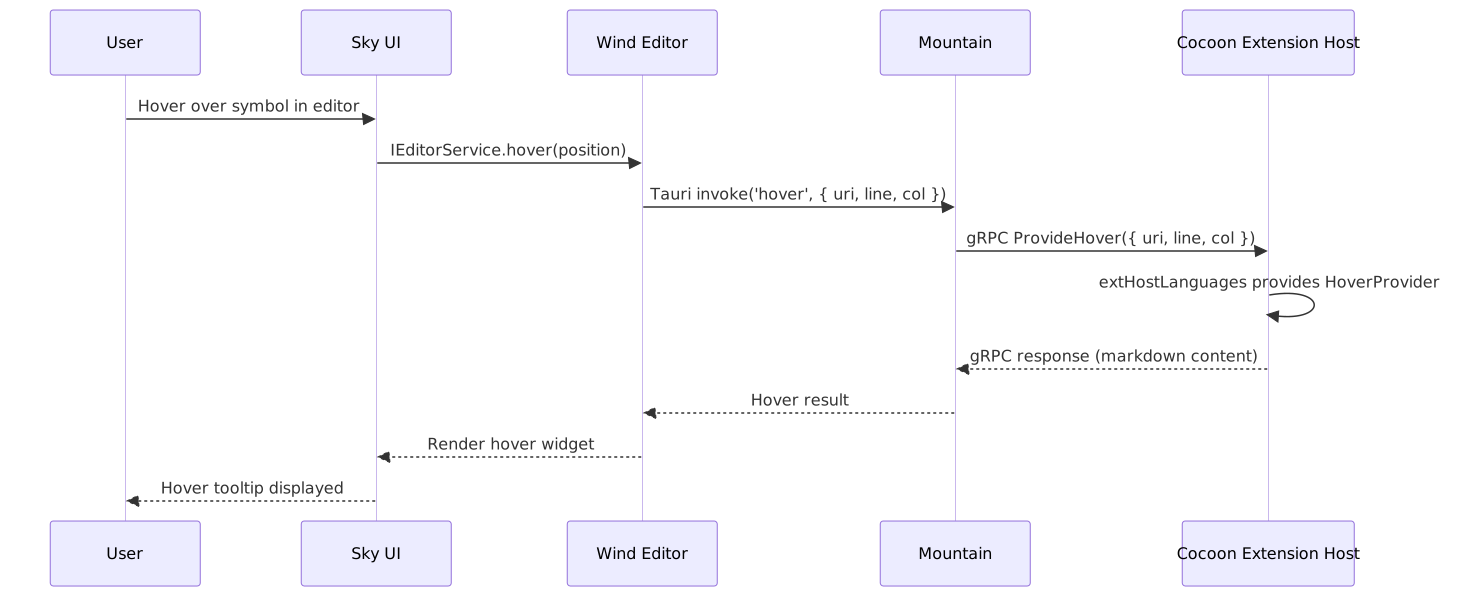
gRPC(bidirectional streaming):MountainandCocooncommunicate via protocol buffers overgRPC. The service contracts are defined inVine.proto.- Used for: extension host initialization, command execution, language feature requests (hover, completion, definition), webview panel communication
TierIPC Routing
Wind and Output both support three routing modes, selected by the TierIPC environment variable:
| Value | Behaviour |
|---|---|
Mountain | All IPC calls route to Mountain Tauri backend (default) |
NodeDeferred | Mountain first; falls back to Cocoon cocoon:request bridge on miss or undefined return |
Node | All calls route to Cocoon Node.js process via cocoon:request bridge |
Per-subsystem tier variables (TierTerminal, TierSCM, TierDebug, TierLanguageFeatures, TierAuth, TierTasks, etc.) override TierIPC for individual channel prefixes. For example, TierTasks=Node and TierAuth=Node are the defaults even when the global TierIPC=Mountain, because those handlers live in Cocoon’s extension host.
This is a runtime switch - no rebuild required. Set in .env.Land as TierIPC=NodeDeferred to enable gradual migration of handlers to Cocoon.
Service Layer Design 🧩
Common Trait Architecture (Rust side)
The Common crate defines application capabilities as abstract async traits. Each trait represents a domain:
Common::Interface
    +-- FileSystem (read, write, watch, stat, mkdir, readdir)
    +-- Configuration (get, set, has, inspect, onDidChange)
    +-- Terminal (create, write, resize, onData)
    +-- Clipboard (read, write, readText, writeText)
    +-- Dialog (open, save, message)
    +-- Window (show, focus, maximize, minimize, close)
    +-- ExtensionManagement (scan, install, uninstall, list)
    +-- Process (spawn, kill, onExit)
Mountain implements every trait with concrete Rust implementations. Cocoon and Wind never implement these traits directly — they call Mountain’s implementations through IPC.
Wind Effect-TS Service Architecture (UI side)
Wind recreates the VS Code workbench service architecture using Effect-TS. Each service follows a consistent module structure:

Services compose into Layer stacks:
| Layer | Components | Purpose |
|---|---|---|
| TauriLiveLayer | All production services | Used in Tauri WebView for development and production |
| ElectronLiveLayer | Electron-compatible services | Used for Electron workbench variant |
| TestLayer | Mock implementations | Used in extension test runner |
Cocoon Bootstrap and Extension Architecture
Cocoon’s bootstrap is lean async - plain async/await functions with no Effect-TS runtime overhead. Stages run sequentially in this order:
- Environment - validate Node version, platform, architecture
- Configuration - resolve
MOUNTAIN_GRPC_PORT(50051) andCOCOON_GRPC_PORT(50052) from env - RPCServer - bind Cocoon’s own gRPC server on port 50052 first, before attempting to connect to
Mountain. This preventsMountain’s 30-second gRPC connection budget from expiring whileCocoon’s port is still unbound. - ModuleInterceptor - install the VS Code module shim
- MountainConnection - connect to
MountaingRPC at port 50051 with exponential-backoff retry (3 TCP probes, 5 connection attempts) - Extensions - activate all enabled extensions (concurrency 8)
- HealthCheck - verify all services are operational
Extension dependencies are activated in topological order with an InProgress Set cycle guard to prevent circular-dependency deadlocks.
The vscode API shim in Cocoon/Source/Services/Handler/VscodeAPI/ uses a two-track dispatch model:
- Track A - Stock Node: Loads unmodified VS Code
extHost*.tssources. TheExtHostContext/MainContextRPC glue is provided byCocoon’s shim alongside stock extension host code. Maximizes compatibility. - Track B - Rust Native: For I/O-heavy APIs,
Cocoon’svscodeshim sendsgRPCrequests toMountainwhich performs the operation natively (filesystem, process, terminal, search, git). Faster than bouncing throughNode.js.
The per-call tier router in Cocoon/Source/Services/Handler/VscodeAPI/ selects the track at runtime.
Tier-Gated Implementation ⚙️
Land uses a configuration-driven selection mechanism for capabilities that have multiple implementation strategies. Each capability is assigned a tier value in .env.Land:
| Capability | Tier Values | Purpose |
|---|---|---|
FileSystem | Layer2 (gRPC), Layer3 (native in-language), Layer4 (pure Rust) | File system access strategy |
RemoteProcedureCall | gRPC, SharedMemory | IPC transport mechanism |
FileWatcher | Layer4, Layer5 (OS-level integration) | File system change notification |
Glob | JavaScript, Native (globset Rust) | Glob pattern compilation |
Telemetry | PostHog, OTLP, Disabled | Telemetry backend selection |
HTTPProxy | Hyper, Standard | HTTP client implementation |
The tier selection propagates through every Element’s build system simultaneously. See Tier-Gated Implementation Selection for the full propagation workflow.
Data Flow Patterns 📊
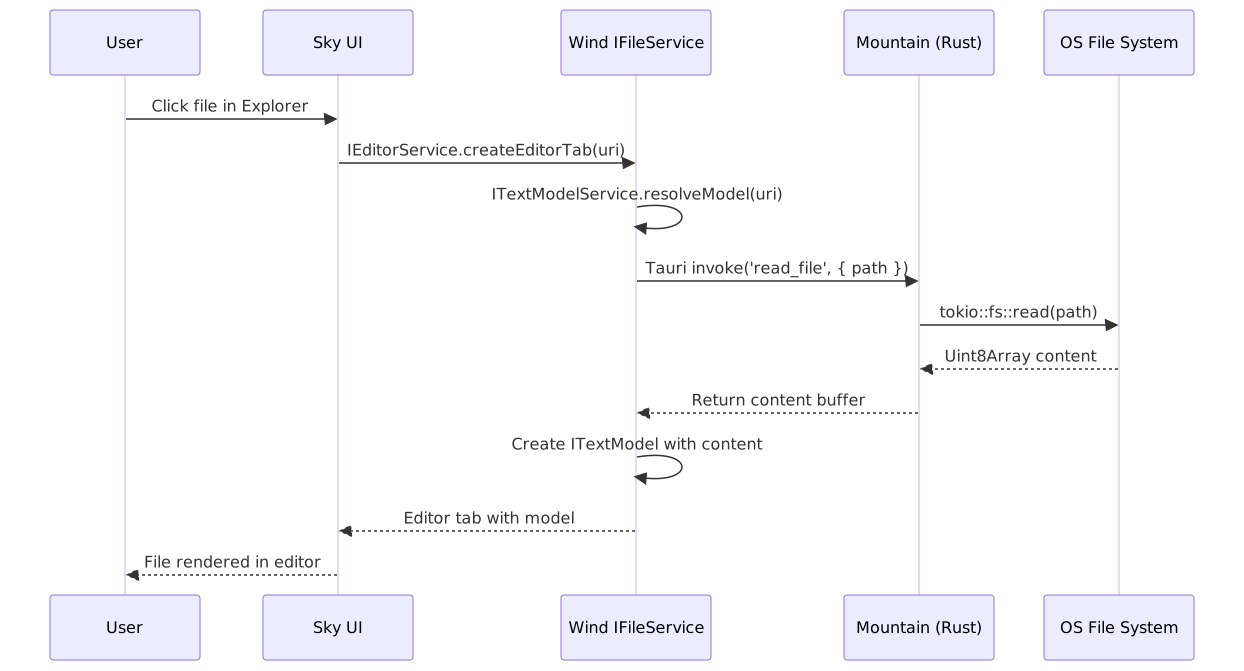
Read Request (File Open)
Extension Feature Request (Hover)
Configuration Change
Related Documentation 📋
- BuildPipeline - Full build pipeline from env files to binary artifacts
- EditorCore - Editor workbench adaptation and
Windservice layer - Polyfills - Compatibility shims and initialization layers
- RustInfrastructure -
Rustbackend component internals - InterComponentProtocol -
gRPCprotocol specification - Building - Build instructions and prerequisites
- BuildMatrix - Build variant profile reference
- EnvironmentVariables - Complete env var reference
- Workflow/ - Detailed component interaction workflows
- VSCode-API-Coverage-Matrix -
vscode.*API implementation status per namespace
Project Maintainers: Source Open (Source/[email protected]) | GitHub Repository | Report an Issue
See Also
- 🟠 Low-Level Shim - Engine-level prototype hooks
- 🔵 Coverage / Telemetry - Application-level service routing