
Deep Dive
Vine - Deep Dive
Vine gRPC protocol layer - technical foundation for strongly-typed inter-process communication between Mountain, Cocoon, and Air. Proto file structure, MountainService and CocoonService RPC definitions, bidirectional streaming patterns, build.rs compilation, URI/Range message formats, and how new RPCs are added.
Vine provides the technical foundation gRPC protocol layer within the Land project. Vine defines the strongly-typed inter-process communication contracts used between Mountain and Cocoon, with Air as an additional gRPC consumer. The .proto files are the canonical source of truth; all Rust and TypeScript implementations are generated from them.
Architecture
Vine is a contract-first protocol layer. The .proto file is the source of truth; generated Rust code via prost-build/tonic is shared by Mountain, Air, and Cocoon.
 ---
---Key Modules
| Path | Description |
|---|---|
Proto/Vine.proto | Canonical protocol schema (only schema shipped) |
Source/Library.rs | Crate root: port constants, protocol version, constants |
Source/Host.rs | VineHost + IPCProvider embedder seam |
Source/Generated/ | prost-built types + tonic clients/servers from Proto/Vine.proto |
Source/Client/ | Connection helpers, request/notification dispatch, sidecar health checks |
Source/Server/ | Bind helpers + notification handler tree |
Source/Multiplexer.rs | Bidirectional streaming envelope multiplexer (LAND_VINE_STREAMING=1) |
Source/Error.rs | Canonical VineError variants |
The protocol implementation spans Mountain’s Source/RPC/Vine/ (server), Air’s Vine client modules, and Cocoon’s Source/Effect/RPCServer.ts (client). The Vine Element owns the schema and shared Rust types.
Port Allocation
All gRPC listeners bind to [::1] (loopback only). No remote connections are accepted.
| Service | Element | Port | Transport | Direction |
|---|---|---|---|---|
| Mountain Vine | Mountain | 50051 | TCP | Cocoon → Mountain (gRPC server) |
| Cocoon Vine | Cocoon | 50052 | TCP | Mountain → Cocoon (gRPC server) |
| Air Vine | Air | 50053 | TCP | Mountain → Air (background daemon) |
Proto File Structure
Three proto files make up the Vine protocol family. All use syntax = "proto3" and the Vine package namespace.
| File | Location | Defines |
|---|---|---|
Vine.proto | Element/Mountain/Proto/Vine.proto | Core Mountain↔Cocoon services |
Spine.proto | Element/Mountain/Proto/Spine.proto | Extension host action/response coordination |
Air.proto | Element/Air/Proto/Air.proto | Mountain↔Air background daemon services |
The proto files are compiled separately for each consumer. Mountain’s build.rs compiles Vine.proto and Spine.proto into Rust types. A separate protoc invocation generates TypeScript stubs committed to Cocoon’s source tree.
MountainService RPC Definitions
MountainService is the gRPC service implemented by Mountain’s tonic server. Cocoon connects as a client and calls these RPCs when extensions need native capabilities.
service MountainService {
    rpc ProcessCocoonRequest(GenericRequest) returns (GenericResponse);
    rpc SendCocoonNotification(GenericNotification) returns (Empty);
    rpc CancelOperation(CancelOperationRequest) returns (Empty);
    rpc OpenChannelFromCocoon(stream Envelope) returns (stream Envelope);
}
ProcessCocoonRequest and SendCocoonNotification carry a method string and a params bytes field containing JSON-encoded arguments. This generic envelope lets the Mountain IPC dispatcher (WindServiceHandlers/mod.rs) route to the correct handler without requiring a new RPC for every method. New IPC methods can be added by registering a handler in mod.rs without touching the proto file.
OpenChannelFromCocoon is a bidirectional streaming RPC. It replaces the older pattern of opening a new unary connection per request for high-frequency callers. Both sides write Envelope messages to the stream; each envelope carries a correlation ID so responses can be matched to outstanding requests on the same stream.
Rust tonic Server Implementation
Mountain’s gRPC server lives in Element/Mountain/Source/Vine/Server/. The tonic #[async_trait] implementation dispatches each RPC:
#[tonic::async_trait]
impl MountainService for MountainVineServiceImpl {
    async fn process_cocoon_request(
        &self,
        request: Request<GenericRequest>,
    ) -> Result<Response<GenericResponse>, Status> {
        let req = request.into_inner();
        // Dispatch to WindServiceHandlers based on req.method
        let result = self.dispatch(&req.method, &req.params).await
            .map_err(|e| Status::internal(e.to_string()))?;
        Ok(Response::new(GenericResponse { result, success: true, error: String::new() }))
    }
    // ...
}
The dispatcher in WindServiceHandlers/mod.rs matches the method string against registered handlers and calls the appropriate Rust function. Each handler lives in its own atomic file under the WindServiceHandlers/ directory.
CocoonService RPC Definitions
CocoonService is implemented by Cocoon’s gRPC server. Mountain connects as a client and calls these RPCs to drive the extension host.
service CocoonService {
    rpc ProcessMountainRequest(GenericRequest) returns (GenericResponse);
    rpc SendMountainNotification(GenericNotification) returns (Empty);
    rpc CancelOperation(CancelOperationRequest) returns (Empty);
    rpc OpenChannelFromMountain(stream Envelope) returns (stream Envelope);
    rpc InitialHandshake(Empty) returns (Empty);
    rpc InitExtensionHost(InitExtensionHostRequest) returns (Empty);
    rpc RegisterCommand(RegisterCommandRequest) returns (Empty);
    rpc ExecuteContributedCommand(ExecuteCommandRequest) returns (ExecuteCommandResponse);
    rpc UnregisterCommand(UnregisterCommandRequest) returns (Empty);
    rpc RegisterHoverProvider(RegisterProviderRequest) returns (Empty);
    rpc ProvideHover(ProvideHoverRequest) returns (ProvideHoverResponse);
    rpc RegisterCompletionItemProvider(RegisterProviderRequest) returns (Empty);
    rpc ProvideCompletionItems(ProvideCompletionItemsRequest) returns (ProvideCompletionItemsResponse);
    rpc RegisterDefinitionProvider(RegisterProviderRequest) returns (Empty);
    rpc ProvideDefinition(ProvideDefinitionRequest) returns (ProvideDefinitionResponse);
    rpc RegisterReferenceProvider(RegisterProviderRequest) returns (Empty);
    rpc ProvideReferences(ProvideReferencesRequest) returns (ProvideReferencesResponse);
    rpc RegisterCodeActionsProvider(RegisterProviderRequest) returns (Empty);
    rpc ProvideCodeActions(ProvideCodeActionsRequest) returns (ProvideCodeActionsResponse);
    rpc RegisterDocumentHighlightProvider(RegisterProviderRequest) returns (Empty);
    rpc ProvideDocumentHighlights(ProvideDocumentHighlightsRequest) returns (ProvideDocumentHighlightsResponse);
    rpc RegisterDocumentSymbolProvider(RegisterProviderRequest) returns (Empty);
    rpc ProvideDocumentSymbols(ProvideDocumentSymbolsRequest) returns (ProvideDocumentSymbolsResponse);
    rpc RegisterWorkspaceSymbolProvider(RegisterProviderRequest) returns (Empty);
    rpc ProvideWorkspaceSymbols(ProvideWorkspaceSymbolsRequest) returns (ProvideWorkspaceSymbolsResponse);
    rpc RegisterInlineCompletionItemProvider(RegisterProviderRequest) returns (Empty);
    rpc ProvideInlineCompletionItems(ProvideInlineCompletionItemsRequest) returns (ProvideInlineCompletionItemsResponse);
}
TypeScript Implementation
Cocoon’s gRPC server (Cocoon/Source/Services/gRPC/Server/Service.ts) uses @grpc/grpc-js with the generated TypeScript stubs. Each Provide* RPC routes to the language feature provider registry:
async provideHover(
    call: ServerUnaryCall<ProvideHoverRequest, ProvideHoverResponse>,
    callback: sendUnaryData<ProvideHoverResponse>,
): Promise<void> {
    const { documentUri, line, column } = call.request;
    const result = await this.languageProviderRegistry
        .invokeProvider("hover", documentUri, { line, character: column });
    callback(null, { markupContent: result?.contents ?? "", ... });
}
The Register* RPCs store provider registrations in a per-language registry. When Mountain later calls the corresponding Provide* RPC, the registry dispatches to the registered extension provider.
ProvideInlineCompletionItems was added to CocoonService as part of the inline completions pipeline. It follows the same Register*/Provide* pattern and is dispatched through the LanguageFeatureProviderRegistry in Cocoon. Sky’s Monaco editor calls language:provideInlineCompletions on Mountain, which routes the request to Cocoon via this RPC.
Bidirectional Streaming Patterns
Vine uses bidirectional streaming for two purposes: multiplexed high-frequency dispatch and real-time event delivery.
Multiplexed Dispatch (OpenChannel*)
OpenChannelFromCocoon and OpenChannelFromMountain are bidirectional streaming RPCs that replace the older one-request-per-connection model. Both sides write Envelope messages:
message Envelope {
    string id = 1;       // correlation ID, UUID v4
    string method = 2;   // IPC method name
    bytes  payload = 3;  // JSON-encoded params or result
    bool   is_reply = 4; // true if this envelope is a response to a prior request
    string error = 5;    // non-empty if is_reply and the call failed
}
The sender writes an Envelope with a unique id and is_reply = false. The receiver processes the request and writes back an Envelope with the same id and is_reply = true. Both sides maintain a HashMap<String, oneshot::Sender<Envelope>> to route replies to waiting callers.
This pattern is particularly important for language feature calls, where the editor may issue dozens of hover and completion requests within a single second. Opening a new TCP connection per request adds ~0.5 ms of overhead; the streaming channel amortises that cost to near zero.
Real-Time Event Delivery (SendMountainNotification)
Notifications (document changes, configuration updates, workspace folder changes) travel via SendMountainNotification, which is a unary fire-and-forget RPC. Mountain calls it without waiting for acknowledgement. Cocoon processes notifications on a dedicated handler that updates its internal caches (__textDocuments, __workspaceFolders, etc.) before dispatching to extension listeners.
Data Flow
The following diagram shows how a VS Code command travels from Sky/Wind through the Vine protocol to Cocoon and back.
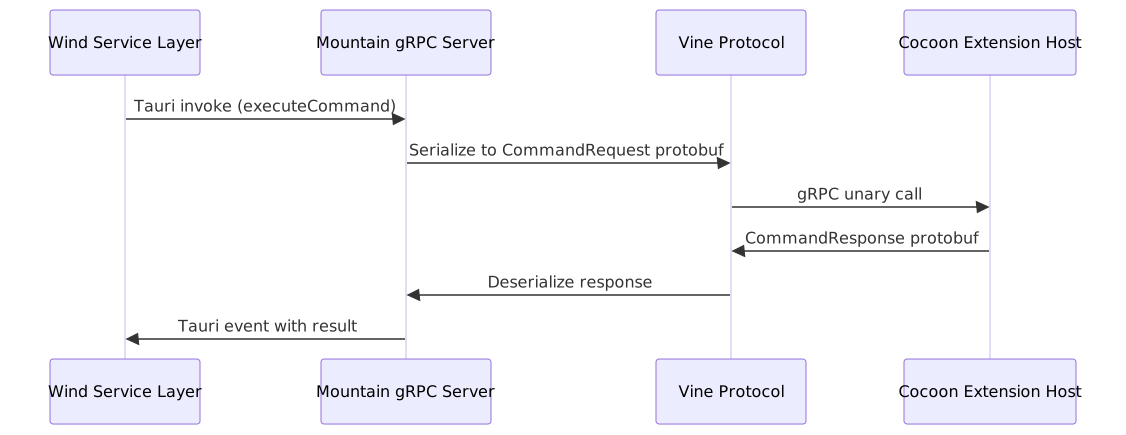 **Communication patterns supported by Vine:**
- Unary RPC - Request/response for commands and queries.
- Server streaming - Mountain streams events (terminal output, diagnostics) to Cocoon.
- Client streaming - Cocoon sends batched registration calls at startup.
- Bidirectional streaming - Used by the Spine protocol for real-time extension host coordination.
Proto Compilation in build.rs
Mountain’s build.rs compiles all proto files at build time:
fn main() {
    tonic_build::configure()
        .build_server(true)
        .build_client(true)
        .compile(
            &["Proto/Vine.proto", "Proto/Spine.proto"],
            &["Proto"],
        )
        .expect("Failed to compile protos");

    // Rerun if any proto file changes
    println!("cargo:rerun-if-changed=Proto/Vine.proto");
    println!("cargo:rerun-if-changed=Proto/Spine.proto");
}
tonic_build invokes prost-build internally. The generated Rust types are written to $OUT_DIR/vine.rs and $OUT_DIR/spine.rs and included via include!(concat!(env!("OUT_DIR"), "/vine.rs")) in Mountain’s Source/Vine/Generated/ module.
The protoc binary must be available on PATH. In the CI environment, it is installed by the prost-build feature flag that bundles protoc. For local development on macOS, brew install protobuf provides it.
URI and Range Message Formats
Vine uses explicit message types for VS Code’s URI and Range primitives rather than encoding them as strings:
message Uri {
    string scheme    = 1;  // "file", "untitled", "git", "output"
    string authority = 2;  // empty for file:// URIs on local files
    string path      = 3;  // POSIX path, percent-encoded
    string query     = 4;
    string fragment  = 5;
}

message Position {
    uint32 line      = 1;  // 0-based line number
    uint32 character = 2;  // 0-based UTF-16 code unit offset
}

message Range {
    Position start = 1;
    Position end   = 2;
}
Important
All line and character positions in Vine messages are 0-based, matching the VS Code Language Server Protocol convention. Mountain’s IPC handlers that bridge between Vine and the Monaco editor must translate from 0-based (Vine) to 1-based (Monaco model) when applying edits, and back to 0-based when constructing Vine responses.
How to Add a New RPC
Adding a new RPC requires coordinated changes across the proto file, Mountain, and Cocoon. The steps below use adding a hypothetical ProvideInlayHints RPC as an example.
Step 1: Add the message and RPC to Vine.proto.
message ProvideInlayHintsRequest {
    Uri    document_uri = 1;
    Range  visible_range = 2;
}

message ProvideInlayHintsResponse {
    repeated InlayHint hints = 1;
}

// In CocoonService:
rpc ProvideInlayHints(ProvideInlayHintsRequest) returns (ProvideInlayHintsResponse);
Step 2: Regenerate TypeScript stubs by running protoc with the --ts_out flag and committing the updated files in Cocoon/Source/Generated/.
Step 3: Add the Mountain handler. Create Element/Mountain/Source/IPC/WindServiceHandlers/Language/ProvideInlayHints.rs implementing the Rust side. Register it in mod.rs dispatch table.
Step 4: Add the Cocoon handler. In Cocoon/Source/Services/gRPC/Server/Service.ts, implement the provideInlayHints method, routing it through the language provider registry.
Step 5: Add the Channel enum entry. Update Common/Source/IPC/Channel.rs (Rust) and Wind/Source/IPC/Channel.ts (TypeScript) with the new channel identifier. These two files must stay in lockstep.
Step 6: Build both sides. cargo build -p Mountain catches Rust compile errors; pnpm run prepublishOnly catches TypeScript errors in Cocoon.
Warning
Never remove or rename a proto field without a migration plan. Proto3 field numbers are permanent identifiers in the wire format. Removing field number 3 and adding a new field at position 3 with a different type corrupts any in-flight message. Add new fields with new numbers; mark old fields as reserved once both sides have been updated.
Air.proto
Air uses a separate proto file with its own BackgroundServices gRPC service on port 50053. The structure mirrors Vine but is scoped to background operations:
service BackgroundServices {
    rpc Connect(ConnectRequest) returns (ConnectResponse);
    rpc Heartbeat(HeartbeatRequest) returns (HeartbeatResponse);
    rpc PerformAction(ActionRequest) returns (ActionResponse);
    rpc CancelAction(CancelRequest) returns (CancelResponse);
    rpc HealthCheck(HealthCheckRequest) returns (HealthCheckResponse);
    rpc GetStatus(StatusRequest) returns (StatusResponse);
}
PerformAction uses a discriminated ActionRequest where the action type field routes to UpdateService, DownloadService, AuthService, or IndexService inside Air.
Integration Points
| Connecting Element | Direction | Mechanism | Description |
|---|---|---|---|
| Mountain | Server | tonic gRPC server | Hosts Vine server on 50051; handles incoming RPC from Cocoon/Air |
| Cocoon | Client | Node.js grpc-js / Bridge | Connects to Mountain’s Vine server |
| Air | Server + Client | tonic gRPC | Hosts AirService on 50053; also connects back to Mountain |
Listening addresses:
| Service | Address |
|---|---|
| Mountain Vine | [::1]:50051 |
| Cocoon Vine | [::1]:50052 |
| Air Vine | [::1]:50053 |
Configuration
| Parameter | Value | Description |
|---|---|---|
| Transport | TCP loopback | [::1] only; no external exposure |
| TLS | Disabled for local IPC | Mist DNS isolation enforces the network boundary |