
Low-Level Shim
Low-Level Shim
🟠 Engine-level prototype hooks for intercepting VS Code at the JavaScript runtime layer
🟠 Low-Level Shim - Engine-Level Interception
🟠 LOW-LEVEL SHIM - JavaScript engine prototype monkey-patches Tier gate:
TierShim=Own|TierShim=PreemptColor:#FF6B35(Orange) Overhead: <2% in production (sampled)
The Low-Level Shim intercepts VS Code at the JavaScript engine level - before any service, any contribution, any extension has a chance to execute. It operates via prototype-level monkey-patches on VS Code’s internal infrastructure classes. When active, it becomes the first code to run after workbench.startup() returns, injecting itself between the runtime and every subsystem of VS Code.
🟠 Full Architecture Diagram
 The architecture has three distinct planes:
- Interception Plane (🟠 orange) - The 6 prototype hooks that wrap VS Code internals
- Diagnostics Plane (🔵 blue) -
LandDiagnostics, the unified ring-buffer tracer - Flush Plane (🟣 purple) - Mountain dev log, OTLP traces, PostHog sampling
🟠 Layer-by-Layer Deep Dive
L1: Error Handler - ErrorHandlerProxy
Intercepts errorHandler.onUnexpectedError(), the single choke-point for every unhandled error in VS Code. Any exception that bubbles up to the workbench’s global error boundary flows through this hook.
// From: Output/Source/Service/CEL/Land/Shim/Intercept/ErrorHandlerProxy.ts
// This module is injected at depth 3 under vs/workbench/browser/
// Dynamic import ensures it resolves at the FINAL on-disk location

import { recordErrorTrace } from "../Diagnostics/LandDiagnostics.js";

const ErrorHandlerProxy = async (): Promise<void> => {
	// Tier gate - only Own/Preempt
	if (__LandTier_Shim__ !== "Own" && __LandTier_Shim__ !== "Preempt") return;

	// Idempotency: globalThis marker prevents double-patching
	const marker = "__LAND_SHIM_LOW_ERROR_HANDLER_PROXY__";
	if ((globalThis as any)[marker]) return;

	try {
		// Dynamic import from VS Code's base layer (guaranteed loaded post-startup)
		const { errorHandler } = await import("../../base/common/errors.js");
		if (!errorHandler) return;

		const originalOnUnexpectedError =
			errorHandler.onUnexpectedError.bind(errorHandler);

		errorHandler.onUnexpectedError = function (error: any): void {
			// 🔴 Record BEFORE VS Code processes the error
			try {
				const trace = {
					ts: Date.now(),
					message:
						error instanceof Error
							? error.message
							: String(error ?? "unknown"),
					stack:
						error instanceof Error
							? (error.stack?.slice(0, 1024) ?? "")
							: "",
					name: error instanceof Error ? error.name : "non-error",
				};
				recordErrorTrace(trace);
			} catch {
				/* Tracing itself must not throw */
			}

			// Pass through to original handler (never swallow errors)
			try {
				return originalOnUnexpectedError(error);
			} catch {
				/* Absorb - original may panic but we already captured trace */
			}
		};

		errorHandler[marker] = true;
	} catch {
		/* Non-fatal - shim must never crash the workbench */
	}
};Coverage: 100% of unhandled errors. Overhead: 0% (error path is already an exception).
L2: Event Emitter - EmitterFireProxy
Intercepts Emitter.prototype.fire(), the single event dispatch mechanism for all 474 decorated services in VS Code. Every status bar update, SCM change, editor state transition, extension notification - all flow through this one prototype method.
// From: Output/Source/Service/CEL/Land/Shim/Intercept/EmitterFireProxy.ts
// The most performance-critical hook - sampled to <1% in production

const SAMPLE_RATE =
	__LandTier_Shim__ === "Own" || __LandTier_Shim__ === "Preempt"
		? typeof __LandDevMode__ === "boolean" && __LandDevMode__
			? 1.0
			: 0.01
		: 0;

let tickCount = 0;

function patchEmitterFire(Emitter: any, marker: string): void {
	const originalFire = Emitter.prototype.fire;

	Emitter.prototype.fire = function (event: any): void {
		tickCount++;

		try {
			// Extract event name from either named events or string events
			const eventName =
				event && typeof event === "object" && "name" in event
					? String(event.name)
					: typeof event === "string"
						? event
						: "";

			// Check LandSwallowMap - if event should be silenced, drop it
			if (eventName && checkLandSwallowMap(eventName)) {
				return; // VS Code listeners never fire
			}

			// Sample-based tracing (1% prod, 100% dev)
			if (
				SAMPLE_RATE > 0 &&
				tickCount % _sampleThreshold(SAMPLE_RATE) === 0
			) {
				recordEmitterTrace({
					ts: Date.now(),
					eventName: eventName || "(anonymous)",
					listenerCount:
						(this._listeners && this._listeners.size) ?? 0,
				});
			}
		} catch {
			/* Tracing must not block dispatch */
		}

		// 🔥 HOT PATH - always call original
		return originalFire.apply(this, arguments);
	};

	Emitter.prototype[marker] = true;
}
Key optimization: Uses a tick counter (incremented integer) instead of Date.now() on the hot path for approximate sampling threshold calculation. The checkLandSwallowMap() call is a fast prefix check (no regex) for high-frequency events like status bar updates and telemetry.
L3: Cancellation Chain - CancellationProxy
Intercepts CancellationTokenSource.prototype.cancel() to record every cancellation with a stack trace. Cancellations are a primary source of async bugs - this hook provides forensic data for race conditions and dangling promise chains.
// From: Output/Source/Service/CEL/Land/Shim/Intercept/CancellationProxy.ts

function patchCancellation(CancellationTokenSource: any, marker: string): void {
	const originalCancel = CancellationTokenSource.prototype.cancel;

	CancellationTokenSource.prototype.cancel = function (): void {
		try {
			const stack = new Error().stack?.slice(0, 1024) ?? "";
			recordCancellationTrace({
				ts: Date.now(),
				stack,
				alreadyCancelled:
					this.token && this.token.isCancellationRequested === true,
			});
		} catch {
			/* Non-blocking */
		}

		return originalCancel.apply(this, arguments);
	};

	CancellationTokenSource.prototype[marker] = true;
}
Why a stack trace? The cancel() call site is often far from where the CancellationTokenSource was created. Capturing the stack reveals the trigger for cancellation, not just the fact that it happened.
L4: Resource Lifecycle - DisposableProxy
Intercepts DisposableStore.prototype.add() and dispose() to track every disposable resource in the workbench. Each disposable is tagged with a unique ID and store identifier for leak detection.
// From: Output/Source/Service/CEL/Land/Shim/Intercept/DisposableProxy.ts

let disposableIdCounter = 0;

function patchDisposableStore(DisposableStore: any, marker: string): void {
	const originalAdd = DisposableStore.prototype.add;
	const originalDispose = DisposableStore.prototype.dispose;

	DisposableStore.prototype.add = function (disposable: any): any {
		const id = ++disposableIdCounter;
		try {
			if (disposable && typeof disposable === "object") {
				disposable.__landDisposableId = id;
				disposable.__landDisposableStore =
					this.__landStoreId ?? "unknown";
			}
			recordDisposableTrace({
				action: "add",
				id,
				ts: Date.now(),
				storeId: this.__landStoreId ?? "anonymous",
				typeName: disposable?.constructor?.name ?? String(disposable),
			});
		} catch {
			/* Non-blocking */
		}
		return originalAdd.apply(this, arguments);
	};

	DisposableStore.prototype.dispose = function (): void {
		try {
			recordDisposableTrace({
				action: "dispose",
				ts: Date.now(),
				storeId: this.__landStoreId ?? "anonymous",
				trackedCount: this._store ? this._store.size : 0,
			});
		} catch {
			/* Non-blocking */
		}
		return originalDispose.apply(this, arguments);
	};
}
Leak detection: When dispose() is not called but the DisposableStore goes out of scope, the __landDisposableId tags remain in the diagnostics buffer, revealing leaked resources.
L5: Async Scheduling - AsyncProxy
Intercepts platform.setTimeout0() (VS Code’s zero-delay timer) and replaces it with a batching scheduler that coalesces rapid microtasks to reduce layout thrash.
// From: Output/Source/Service/CEL/Land/Shim/Intercept/AsyncProxy.ts

const BATCH_WINDOW_MS = 0; // microtask-level batching
const MAX_BATCH_SIZE = 64; // force flush at 64 queued callbacks

let batchQueue: Array<() => void> = [];
let batchFlushPending = false;
let batchCallCount = 0;

function patchSetTimeout0(platformModule: any, marker: string): void {
	const originalSetTimeout0 = platformModule.setTimeout0;

	platformModule.setTimeout0 = function (callback: () => void): void {
		batchCallCount++;
		batchQueue.push(callback);

		// Sample trace every 128th call (bitwise AND for speed)
		if ((batchCallCount & 0x7f) === 0) {
			try {
				recordAsyncTrace({
					ts: Date.now(),
					queueLength: batchQueue.length,
					totalCalls: batchCallCount,
				});
			} catch {
				/* Non-blocking */
			}
		}

		if (!batchFlushPending) {
			batchFlushPending = true;
			originalSetTimeout0(() => flushBatch(originalSetTimeout0));
		}

		if (batchQueue.length >= MAX_BATCH_SIZE) {
			flushBatch(originalSetTimeout0);
		}
	};
}

function flushBatch(originalSetTimeout0: Function): void {
	const batch = batchQueue;
	batchQueue = [];
	batchFlushPending = false;

	// Execute all callbacks inline - preserves microtask ordering
	for (let i = 0; i < batch.length; i++) {
		try {
			batch[i]();
		} catch {
			/* Individual callback failures must not break the batch */
		}
	}
}
Batching strategy:
- Window=0ms: Calls within the same synchronous turn are batched into one microtask tick
- Max batch=64: Prevents unbounded growth under rapid-fire scheduling
- Trace every 128th: Bitwise
& 0x7favoids modulo division on the hot path
L8: Performance Timing - TimingProxy
Intercepts the StopWatch class to record microsecond-level timing data. This hook wraps the constructor (via proxy), stop(), and elapsed() with high-resolution timestamps from performance.now() or process.hrtime().
// From: Output/Source/Service/CEL/Land/Shim/Intercept/TimingProxy.ts

// High-resolution time source: performance.now (μs) or process.hrtime (ns→μs)
const hrNow =
	typeof performance !== "undefined" && typeof performance.now === "function"
		? () => performance.now()
		: typeof process !== "undefined" && typeof process.hrtime === "function"
			? () => {
					const t = process.hrtime();
					return t[0] * 1e6 + t[1] / 1e3;
				}
			: () => Date.now() * 1000;

function patchStopWatch(
	StopWatch: any,
	marker: string,
	stopwatchModule: any,
): void {
	let stopwatchIdCounter = 0;
	const originalConstructor = StopWatch;

	const ProxiedStopWatch = function (
		this: any,
		highResolution?: boolean,
	): any {
		const id = ++stopwatchIdCounter;
		const instance = originalConstructor.create
			? originalConstructor.create.call(
					originalConstructor,
					highResolution,
				)
			: new originalConstructor(highResolution);

		// Record construction with microsecond precision
		recordTimingTrace({
			action: "create",
			id,
			ts: Date.now(),
			highResolution: !!highResolution,
			micros: hrNow(),
		});

		// Patch instance.stop()
		if (instance?.stop) {
			const originalStop = instance.stop.bind(instance);
			instance.stop = function () {
				const result = originalStop();
				recordTimingTrace({
					action: "stop",
					id,
					ts: Date.now(),
					micros: hrNow(),
					elapsedRaw: result,
				});
				return result;
			};
		}

		// Patch instance.elapsed()
		if (instance?.elapsed) {
			const originalElapsed = instance.elapsed.bind(instance);
			instance.elapsed = function () {
				const result = originalElapsed();
				recordTimingTrace({
					action: "elapsed",
					id,
					ts: Date.now(),
					micros: hrNow(),
					value: result,
				});
				return result;
			};
		}

		return instance;
	};

	// Replace module-level reference so all future imports get the proxy
	stopwatchModule.StopWatch = ProxiedStopWatch;
}
Why L8 (not L6/L7)? Layers L6 (Promise constructor) and L7 (Error.stack capture) are dev-only hooks excluded from production builds. They’re reserved for future diagnostic features.
🟠 Performance Overhead Table
| Layer | Intercepts | Prod Overhead | Dev Overhead | Sampling | Mechanism |
|---|---|---|---|---|---|
| L1 | errorHandler.onUnexpectedError() | 0% | 0% | 100% | Error path is already exceptional |
| L2 | Emitter.prototype.fire() | <1% | 100% trace | 1% prod / 100% dev | Tick counter modulo, prefix check |
| L3 | CancellationTokenSource.cancel() | ~0% | <0.1% | 100% | Cancellations are sparse |
| L4 | DisposableStore.add/dispose | ~0% | <0.5% | 100% | ID counter, tag assignment only |
| L5 | setTimeout0 / async scheduler | 1-2% | 2-3% | 1/128th | Batch coalescing reduces actual calls |
| L8 | StopWatch / performance.now() | 2-3% | 100% trace | 100% (sparse) | Constructor proxy overhead, sparse usage |
Aggregate production overhead: <2% with 1% EmitterFire sampling. The dominant cost is L5 (async batching), but this is offset by the reduction in layout thrash from coalescing microtasks.
In development mode (__LandDevMode__=true), EmitterFire samples at 100% and all tracing is enabled. This adds 5-8% total overhead but provides full visibility for debugging.
🟠 TierShim Activation Table
| TierShim | Level Name | L1 Error | L2 Emitter | L3 Cancel | L4 Dispose | L5 Async | L8 Timing | Service Audit | Service Replace | BrowserMain |
|---|---|---|---|---|---|---|---|---|---|---|
None | 🟢 Off | - | - | - | - | - | - | - | - | - |
Proxy | 🔵 Audit | - | - | - | - | - | - | ✅ | - | - |
Replace | 🔵 Replace | - | - | - | - | - | - | ✅ | ✅ (telemetry) | - |
Own | 🟠 Own | ✅ | ✅ | ✅ | ✅ | ✅ | ✅ | ✅ | ✅ | - |
Preempt | 🟠 Preempt | ✅ | ✅ | ✅ | ✅ | ✅ | ✅ | ✅ | ✅ | ✅ |
Key insight: TierShim=Proxy activates only the 🔵 coverage tier (ServiceCollection audit). TierShim=Replace adds service descriptor replacement. The 🟠 low-level hooks (L1-L8) only activate at Own and above. Preempt additionally gives Land control of BrowserMain.open().
🟠 Source File Map
| # | File | Layer | VS Code Module Intercepted | Purpose |
|---|---|---|---|---|
| 1 | Output/Source/Service/CEL/Land/Shim/Init.ts | Bootstrap | workbench.startup() return value | Entry point injected by Output Transform; reads TierShim, activates hooks |
| 2 | Output/Source/Service/CEL/Land/Shim/Intercept/ErrorHandlerProxy.ts | L1 | vs/base/common/errors.js → errorHandler.onUnexpectedError() | Error boundary interception |
| 3 | Output/Source/Service/CEL/Land/Shim/Intercept/EmitterFireProxy.ts | L2 | vs/base/common/event.js → Emitter.prototype.fire() | Event dispatch interception |
| 4 | Output/Source/Service/CEL/Land/Shim/Intercept/CancellationProxy.ts | L3 | vs/base/common/cancellation.js → CancellationTokenSource.prototype.cancel() | Cancellation chain interception |
| 5 | Output/Source/Service/CEL/Land/Shim/Intercept/DisposableProxy.ts | L4 | vs/base/common/lifecycle.js → DisposableStore.prototype.add/dispose | Resource lifecycle tracking |
| 6 | Output/Source/Service/CEL/Land/Shim/Intercept/AsyncProxy.ts | L5 | vs/base/common/platform.js → platform.setTimeout0() | Async scheduling interception |
| 7 | Output/Source/Service/CEL/Land/Shim/Intercept/TimingProxy.ts | L8 | vs/base/common/stopwatch.js → StopWatch.constructor/stop/elapsed | Performance timing interception |
| 8 | Output/Source/Service/CEL/Land/Shim/Intercept/Index.ts | - | - | Barrel export for all 6 proxies |
| 9 | Output/Source/Service/CEL/Land/Shim/Diagnostics/LandDiagnostics.ts | Diagnostics | - | Unified ring-buffer tracer with flush to Mountain |
| 10 | Output/Source/Service/CEL/Land/Shim/Index.ts | - | - | Top-level barrel: Init + Diagnostics + Intercepts |
| 11 | Output/Source/Service/CEL/Null/Telemetry/Service.ts | 🔵 Replace | vs/platform/telemetry/common/telemetry.ts | No-op telemetry service (all publicLog are void) |
| 12 | Output/Source/Service/CEL/Null/Extension/Gallery/Service.ts | 🔵 Replace | vs/platform/extensionManagement/common/ | Offline extension gallery (empty results, reject downloads) |
| 13 | Output/Source/Service/CEL/Null/Update/Service.ts | 🔵 Replace | vs/platform/update/common/update.ts | No-op update service (air-based updates only) |
Compilation path: Files 2-9 are compiled by Output’s esbuild step to Configuration/Service/CEL/Land/Shim/ and copied to Target/Microsoft/VSCode/vs/workbench/browser/CEL/Land/Shim/ at depth 3. Import paths resolve at this final on-disk location.
🟠 Bootstrap Flow
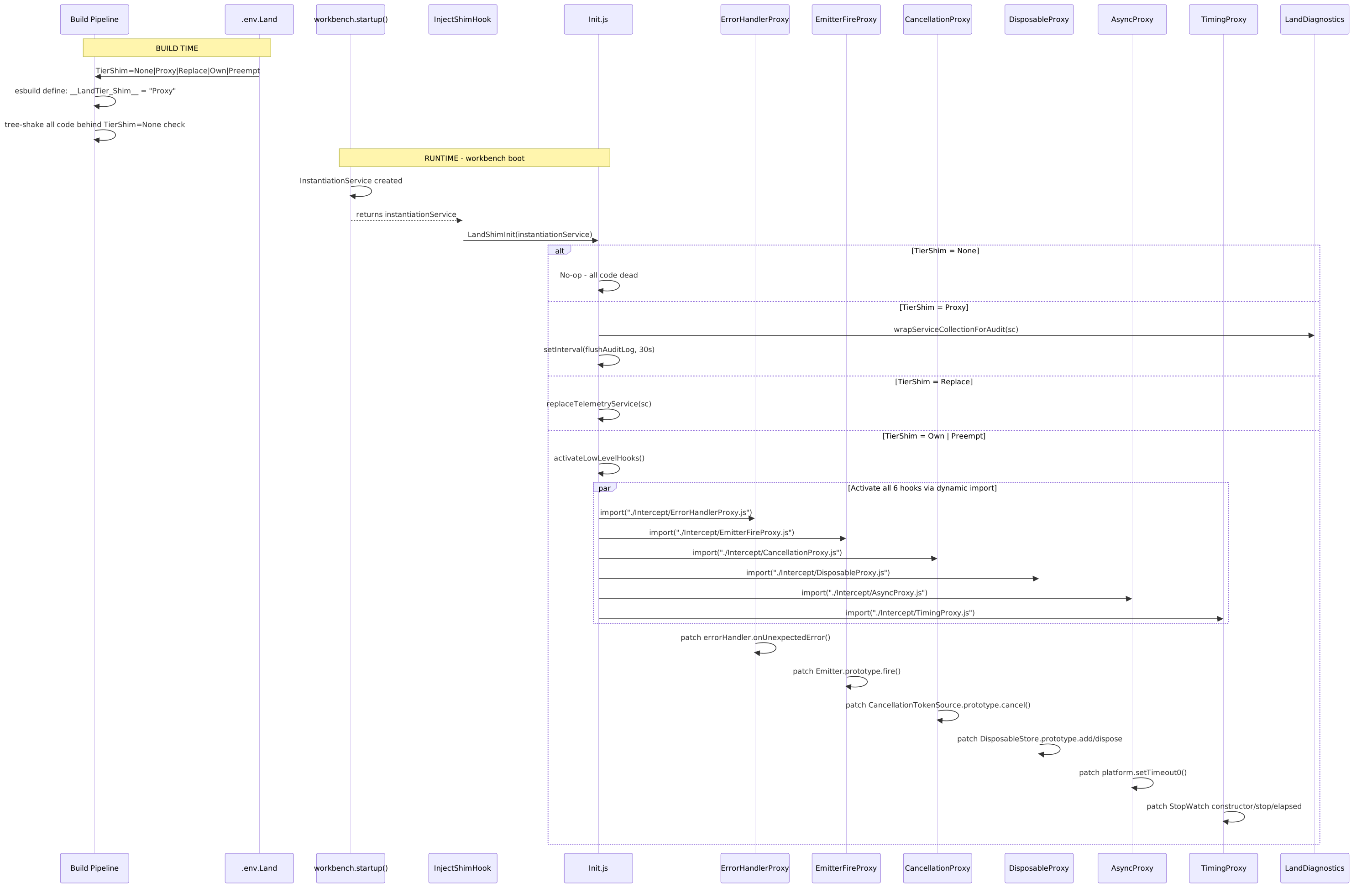 **Critical detail**: The low-level hooks activate via **dynamic `import()`**, not static import. This is because they must resolve at the final on-disk location inside the VS Code tree (`vs/workbench/browser/CEL/Land/Shim/Intercept/`). Each `import()` returns a Promise; `.catch(() => {})` ensures a failed import never crashes the workbench.
🟠 Error Handling: Never Crash the Workbench
Every single hook follows a strict error absorption contract:
// THE CONTRACT - applied uniformly across all 6 hooks
try {
    // 1. Try to patch the prototype
    patchThePrototype();
} catch {
    // 2. Never crash - shim failures are non-fatal
}

// Inside the patched function:
function patchedFunction(...args) {
    try {
        // 3. Record trace data (fire-and-forget)
        recordTrace({...});
    } catch {
        // 4. Tracing itself must not throw
    }

    // 5. ALWAYS call the original (or return - never skip the original silently)
    return originalFunction.apply(this, arguments);
}
Four layers of error absorption:
| Layer | What it protects | Example |
|---|---|---|
| Import guard | Failed dynamic imports | import("...").catch(() => {}) |
| Gate check | Wrong TierShim level | if (TierShim !== "Own") return; (early exit, no patching) |
| Idempotency marker | Double-patching | if (globalThis[marker]) return; |
| Try/catch wrapper | Tracing failures | try { recordTrace() } catch {} inside every patch |
The principle: a shim failure must never prevent VS Code from functioning. If a hook fails to install, VS Code runs un-instrumented but working. If tracing fails mid-flight, the original code still executes.
🟠 Flush Mechanism: How Trace Data Reaches Mountain
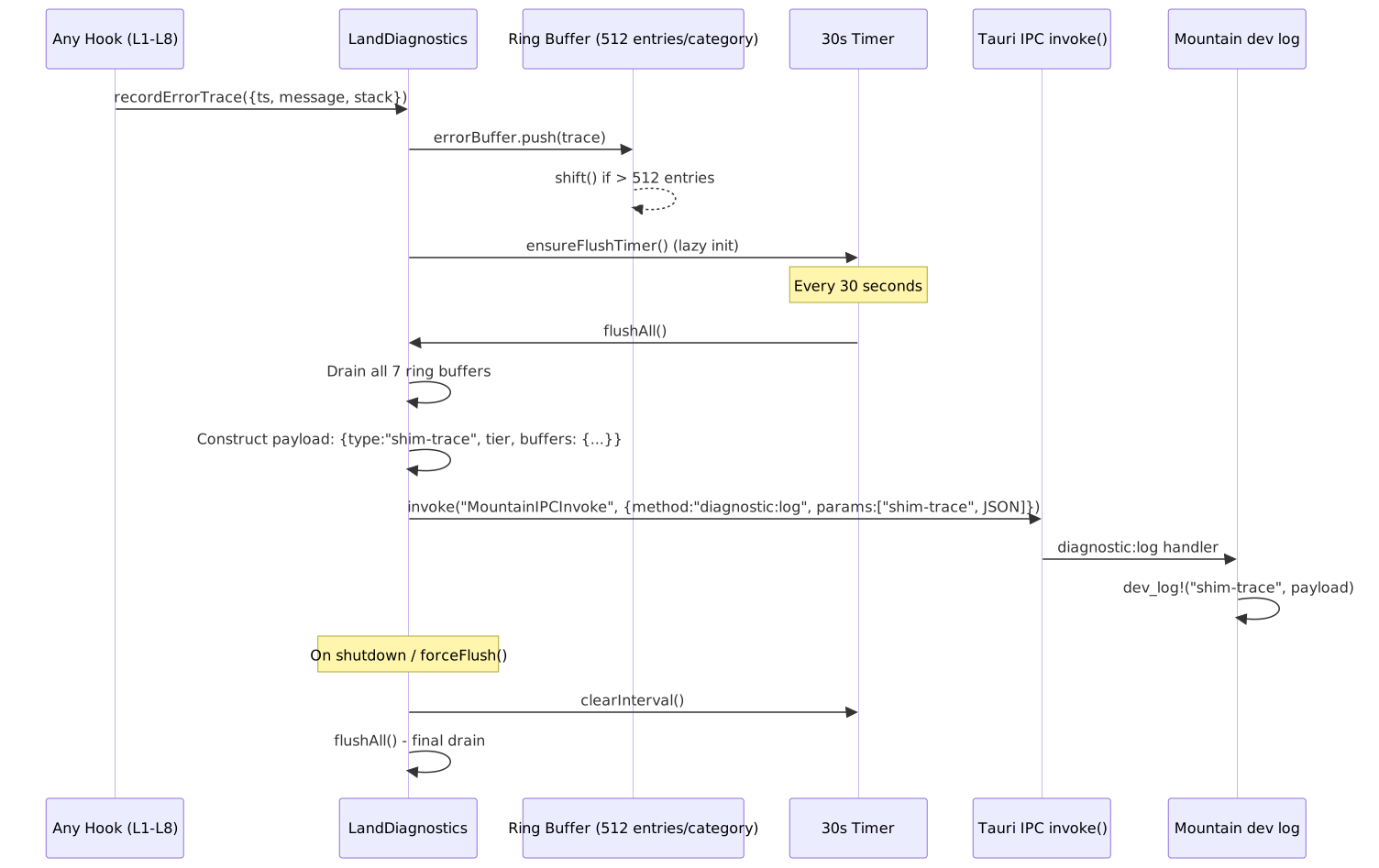 **Ring buffer structure** (per category, max 512 entries):
| Buffer | Category | Recorded by |
|---|---|---|
errorBuffer | Unhandled errors | L1 ErrorHandlerProxy |
emitterBuffer | Event dispatches (sampled) | L2 EmitterFireProxy |
cancelBuffer | Cancellation events | L3 CancellationProxy |
disposableBuffer | Resource add/dispose | L4 DisposableProxy |
asyncBuffer | Async scheduling (1/128th) | L5 AsyncProxy |
timingBuffer | StopWatch operations | L8 TimingProxy |
auditBuffer | Service resolutions | ServiceCollection wrapper |
Flush payload format (sent to Mountain’s diagnostic:log method):
{
    "type": "shim-trace",
    "ts": 1718239200000,
    "tier": "Own",
    "buffers": {
        "error":    { "count": 3,  "sample": [{...}, {...}] },
        "emitter":  { "count": 47, "sample": [{...}, {...}] },
        "cancel":   { "count": 12, "sample": [{...}, {...}] },
        "disposable": { "count": 89, "sample": [{...}, {...}] },
        "async":    { "count": 2,  "sample": [{...}, {...}] },
        "timing":   { "count": 15, "sample": [{...}, {...}] },
        "audit":    { "count": 34, "sample": [{...}, {...}] }
    }
}
Only the first 20 entries per category are sent as a sample to keep payload size bounded.
🟠 Real-World Example: Status Bar Update Trace
Here’s how a user clicking the status bar to change the encoding propagates through all 6 hook layers:
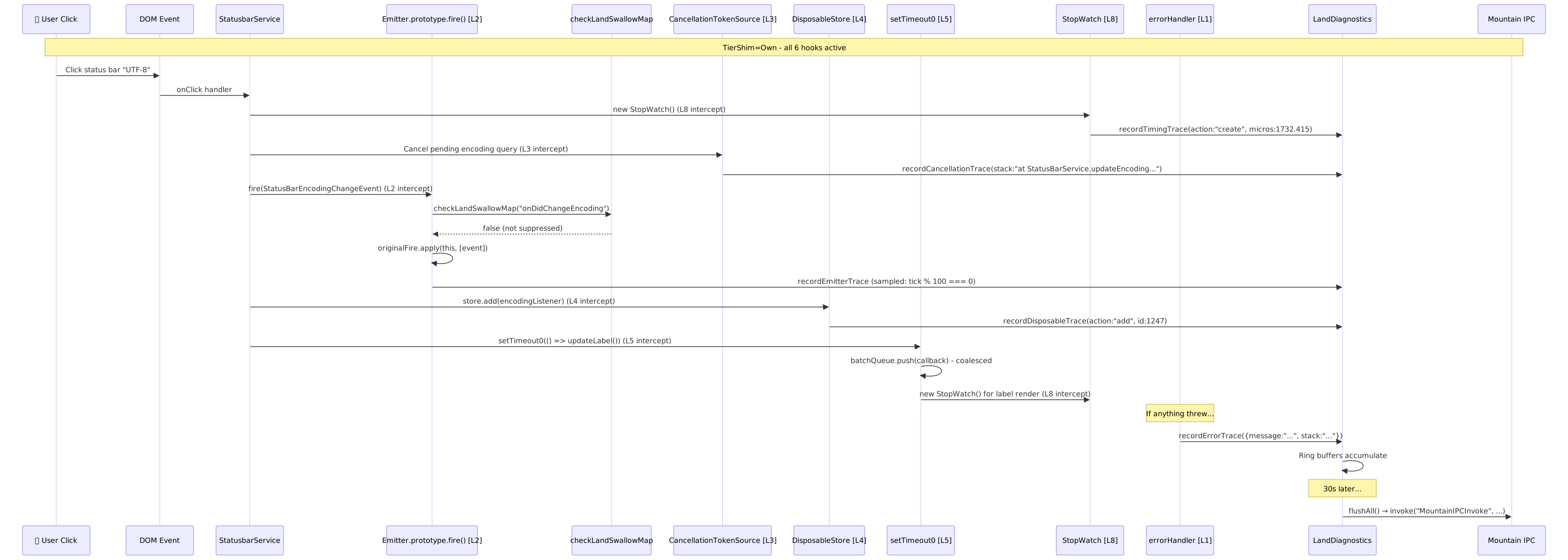 **Trace data captured from this single user action**:
| Layer | Events Captured | Data |
|---|---|---|
| L8 | 2× StopWatch create, 2× stop | Encoding query: 3.2ms, Label render: 1.1ms |
| L3 | 1× cancellation | Stack trace showing StatusBarService.updateEncoding |
| L2 | 2× Emitter fire (sampled if tick%100===0) | onDidChangeEncoding, onDidChangeStatus |
| L4 | 1× DisposableStore.add | Listener ID 1247, typeName “Function” |
| L5 | 1× setTimeout0 coalesced | Queue length 3, batch flushed |
All this data flows to Mountain dev log within 30 seconds, providing a forensic trace of every user interaction when TierShim=Own.
🟠 Idempotency and Safety
Every hook follows a strict idempotency protocol using globalThis markers:
// Pattern applied to EVERY hook
const marker = "__LAND_SHIM_LOW_<HOOK_NAME>_PROXY__";

// During import:
if ((globalThis as any)[marker]) return; // Already patched - skip

// After successful patch:
proto[marker] = true; // Mark as patched
This prevents double-patching if the hook module is imported multiple times (e.g., during hot reload in development). The markers are also visible in DevTools for debugging:
// In DevTools console:
Object.keys(globalThis).filter((k) => k.startsWith("__LAND_SHIM_LOW_"));
// → ["__LAND_SHIM_LOW_ERROR_HANDLER_PROXY__", "__LAND_SHIM_LOW_EMITTER_FIRE_PROXY__", ...]
🟠 Dead Code Elimination
When TierShim=None (the default), esbuild’s define substitution replaces __LandTier_Shim__ with the string literal "None". Since every hook’s gate check is:
if (__LandTier_Shim__ !== "Own" && __LandTier_Shim__ !== "Preempt") return;esbuild evaluates this as if ("None" !== "Own" && "None" !== "Preempt") → if (true) → entire module body is dead code. Combined with --tree-shaking=true, all shim code is completely removed from production builds. Zero bytes, zero runtime cost.
🟠 Related Documentation
- Coverage / Telemetry - The high-level application shim (🔵 blue)
- Architecture - System architecture overview
- Deep Dive: Mountain - Rust-side intercept infrastructure
- Environment Variables - TierShim and TierSwallow* vars
- Build Pipeline - Output Transform injection
⚠️ EXPERIMENTAL - This component operates at the JavaScript engine level. Changes to VS Code’s internal classes may require updates to these hooks. Production overhead: <2% with sampling. Zero overhead when TierShim=None.