
The complete build pipeline for the Land code editor, from environment variable resolution through binary artifact production. The pipeline coordinates Rust, TypeScript, and static asset compilation across 15+ component workspaces.
Pipeline Overview
The Land build has six stages:
- VS Code platform compile - produces the compiled JavaScript platform code
- TypeScript build -
pnpm prepublishOnlyfor Wind, Cocoon, Output, Sky, Worker - PreBake - walks extension roots, writes
extensions.manifest.json - Rust build -
cargo build -p Mountain - Tauri bundle -
pnpm tauri build - Re-sign - strips quarantine bits and re-applies entitlements
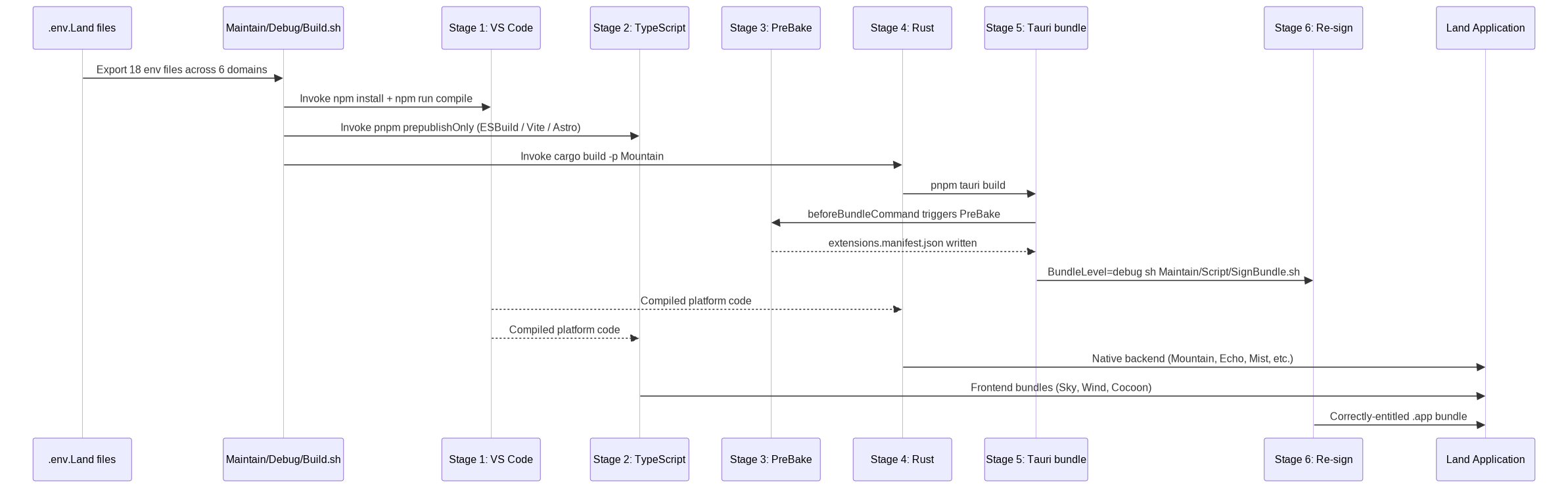
What you should see: after stage 6 the pipeline has written the Mountain binary and the bundled .app under Element/Mountain/Target/; the full tree is enumerated under Artifact Layout below. The resolved tier table echoed at the start of the run is the record of which configuration that build used.
Stage 1: VS Code Platform Compilation
The VS Code source is vendored as a Git submodule at Dependency/Microsoft/Dependency/Editor. This stage produces the compiled JavaScript platform code that Cocoon and Sky consume.
Important
This step is a mandatory prerequisite for every Land build. You must be on Node 24 (tracked in .nvmrc).
cd Dependency/Microsoft/Dependency/Editor
nvm use 24
git fetch --all
git reset --hard Parent/main
git clean -dfx
pnpm install
pnpm run compile
pnpm run compile-extensions-build
The compile-extensions-build step produces out-<platform> directories containing compiled extension JavaScript and metadata. These are consumed by Output for bundling into @codeeditorland/output.
Stage 2: Land Application Assembly
Stage 2 compiles the native Rust backend and bundles the TypeScript frontend into a runnable Tauri application:
cd Land
export Trace=all Record=1 Disable=false
./Maintain/Debug/Build.sh --profile debug-electron-bundled
The build script invokes, in sequence:
TypeScript build (
pnpm prepublishOnly) - Output, Cocoon, Worker, Wind, SkyPreBake - runs via
beforeBundleCommandinsidetauri.conf.json; walks extension roots and writesextensions.manifest.json. Fires in all build paths (directpnpm tauri build,Build.sh, CI). Consumed byLoadFromCache.rsat boot (<50ms vs ~1200ms live scan).Rust workspace compilation via
cargo build -p MountainTauri bundling for the final
.appbundleRe-sign - strips macOS quarantine bits with
xattr -cr, then re-signs withcodesign --force --deep --sign -plusEntitlements.plist:BundleLevel=debug sh Maintain/Script/SignBundle.sh
Environment Variable System
Land uses a multi-file .env system with 18 files across 6 domains.
File Discovery
The build script resolves env files in this priority order:
$Land_Env_File(if explicitly exported).env.Land(local gitignored overrides)../.env.Land(one level up).env.Land.Sample(checked-in defaults)../.env.Land.Sample
The resolved file is sourced via set -a; . "$EnvFile"; set +a, exporting every key-value pair into the shell environment so every child tool inherits the same variable set.
File Hierarchy by Domain
| Domain | Suffix | Dev File | Sample File | Production File |
|---|---|---|---|---|
| Core | (none) | .env.Land | .env.Land.Sample | .env.Land.Production |
| Node | .Node | .env.Land.Node | .env.Land.Node.Sample | .env.Land.Production.Node |
| Extensions | .Extensions | .env.Land.Extensions | .env.Land.Extensions.Sample | .env.Land.Production.Extensions |
| PostHog | .PostHog | .env.Land.PostHog | .env.Land.PostHog.Sample | .env.Land.Production.PostHog |
| Diagnostics | .Diagnostics | .env.Land.Diagnostics | .env.Land.Diagnostics.Sample | .env.Land.Production.Diagnostics |
| Bundled | .Bundled | .env.Land.Bundled | .env.Land.Bundled.Sample | .env.Land.Production.Bundled |
Profile-to-File Mapping
Each build profile loads a specific combination of env files:
| Profile | Files Loaded | Purpose |
|---|---|---|
| Development | .env.Land | Default local development |
| Development + Bundled | .env.Land + .env.Land.Bundled | Dev with pre-compiled workbench |
| Development + Extensions | .env.Land + .env.Land.Extensions | Dev with extension installation |
| Development + Node | .env.Land + .env.Land.Node | Dev with specific Node version |
| Development + PostHog | .env.Land + .env.Land.PostHog | Dev with telemetry |
| Development + Diagnostics | .env.Land + .env.Land.Diagnostics | Dev with debug tracing |
| Production | .env.Land.Production | Release build |
| Production + Bundled | .env.Land.Production + .env.Land.Production.Bundled | Release with bundled workbench |
| Production + Extensions | .env.Land.Production + .env.Land.Production.Extensions | Production with extension skip |
| Production + Node | .env.Land.Production + .env.Land.Production.Node | Production with specific Node |
| Production + PostHog | .env.Land.Production + .env.Land.Production.PostHog | Production with telemetry |
| Production + Diagnostics | .env.Land.Production + .env.Land.Production.Diagnostics | Production with trace/record |
Profile System
Available Build Profiles
| Profile String | Workbench | Feature Coverage | Output Type |
|---|---|---|---|
debug | Browser | 70-80% | Dev binary |
debug-mountain | Mountain | 80-90% | Dev binary (recommended) |
debug-electron | Electron | 95%+ | Dev binary |
debug-electron-rest | Electron + OXC | 95%+ + fastest TS | Dev binary |
debug-electron-minimal | Electron | No built-in extensions | Dev binary |
debug-mountain-only | Mountain | No Cocoon subprocess | Dev binary |
debug-cocoon-headless | None | Mountain + Cocoon, Wind disabled | Dev binary |
debug-kernel | None | Pure Mountain, no built-ins | Dev binary |
debug-electron-compiled | Electron | Single-binary embedded resources | Dev binary |
debug-mountain-compiled | Mountain | Single-binary embedded resources | Dev binary |
debug-electron-bundled | Electron | Vite/Astro compiled workbench | Dev binary |
debug-browser-bundled | Browser | Vite/Astro compiled workbench | Dev binary |
debug-sessions-bundled | Sessions | Vite/Astro compiled workbench | Dev binary |
debug-workbench-bundled | Workbench | Vite/Astro compiled workbench | Dev binary |
debug-bundled-all | All four | Single Rollup pass | Dev binary |
production-electron-bundled | Electron | Optimized release | Prod binary |
production-electron-unbundled | Electron | Release without bundled assets | Prod binary |
Program Launch Options
| Flag | Effect |
|---|---|
--run | Launch application immediately after build |
--profile <name> | Select build profile (default: debug) |
--help | Show profile documentation |
Env Propagation to Each Element
Each Element reads the resolved environment variables through its own build system path:

Rust Elements (Mountain, Common, Echo, Mist, Rest, SideCar, Air, Grove, Vine)
Maintain/Debug/Build.sh
    |
    | exports every Tier* and Product* env var
    v
Cargo / build.rs
    |
    +---> PropagateTierGating() emits:
    |       cargo:rustc-env=Tier<Capability>=<Value>
    |       cargo:rustc-cfg=feature="Tier<Capability><Value>"
    |       cargo:rerun-if-changed=<envfile>
    |
    v
Mountain/src/main.rs
    |
    +---> env!("TierFileSystem")       // compile-time constant
    +---> #[cfg(feature = "TierFileSystemLayer4")]  // conditional compilation
TypeScript Elements (Cocoon)
Maintain/Debug/Build.sh
    |
    | serialises every Tier* var into CocoonEsbuildDefine JSON blob
    v
Cocoon/Source/Configuration/ESBuild/Config/TargetConfig.ts
    |
    | merges blob into esbuild define map
    v
ESBuild bundle
    |
    | __LandTier_FileSystem__ is substituted at bundle time
    v
Cocoon/Source/Bootstrap/Implementation/CocoonMain.ts
    |
    | populates globalThis.__LandTiers from substituted identifiers
    | falls through to process.env.Tier<Capability>
    | falls through to hard-coded defaults
    v
Cocoon/Source/Utility/Tier.ts
    |
    | exposes const Tier = { ... } as const
TypeScript Elements (Sky/Wind)
Maintain/Debug/Build.sh
    |
    | exports Tier* and Product* env vars
    v
Sky/astro.config.ts
    |
    | forwards every Tier* env var to Vite define map
    v
Vite bundle
    |
    | import.meta.env.TierFileSystem is substituted at build time
    v
Wind/Source/Utility/Tier.ts
    |
    | reads import.meta.env.Tier<Capability>
    | falls through to globalThis.__LandTiers
    | falls through to hard-coded defaults
    | emits console.info() boot banner
Cross-Element Agreement
All three runtime banners must report identical tier values:
| Element | Banner Mechanism |
|---|---|
Mountain | Rust env!() banner |
Cocoon | LandFixLog.Info banner |
Wind | console.info banner |
A mismatch indicates one build tool read a different env file.
Rust Build Process
Workspace Structure
The Rust elements form a workspace at Land/Cargo.toml:
[workspace]
members = [
    "Element/Common",
    "Element/Echo",
    "Element/Mist",
    "Element/Mountain",
    "Element/Rest",
    "Element/SideCar",
    "Element/Air",
    "Element/Grove",
    "Element/Vine",
]
build.rs Tier Propagation
Every Rust element with tier-gated features has a build.rs that:
- Calls
PropagateTierGating()which scans the resolved env file - Emits
cargo:rustc-env=for every row (defaults + overrides) - For non-default values, emits
cargo:rustc-cfg=feature="Tier<Capability><Value>" - Calls
IsDeclaredTierFeature()to validate againstCargo.toml [features] - Calls
IsDefaultTierValue()to identify no-op default values - Emits
cargo:warning=for any unrecognized(Key, Value)pair
TypeScript Build Process
ESBuild Compilation (Cocoon, Output, Worker)
Cocoon, Output, and Worker compile through ESBuild with:
- Env-injected defines via
CocoonEsbuildDefineJSON blob - Target configuration via
TargetConfig.ts(resolves platform, arch, profile) - Output to
Element/<Name>/Target/orElement/<Name>/Compiled/
Vite/Astro Compilation (Sky, Wind)
Sky and Wind compile through Vite with Astro:
- Vite define map receives every
Tier*env var asimport.meta.env.Tier* - Astro pages are rendered to static HTML + JS bundles
- SkyBridge (~2900 lines) is compiled as the runtime event bridge
- Output to
Element/Sky/Target/
Artifact Layout
After a successful build, artifacts are placed in per-Element target directories:
Land/Element/
├── Mountain/Target/
│   ├── debug/Mountain
│   ├── debug/bundle/macos/Mountain.app
│   └── debug/extensions.manifest.json
├── Air/Target/
├── Cocoon/Compiled/
│   ├── cocoon-bootstrap.js
│   └── bundles/
├── Output/Target/
│   └── @codeeditorland/output/
├── Sky/Target/Static/
│   ├── Application/      # VS Code workbench assets
│   └── Bundled/Electron/ # Vite-bundled workbench
└── Wind/Target/
    └── Function/Install/
Notable artifacts:
| Path | Description |
|---|---|
Element/Mountain/Target/<level>/Mountain | Native binary |
Element/Mountain/Target/<level>/bundle/macos/*.app | Signed .app bundle |
Element/Mountain/Target/<level>/extensions.manifest.json | Pre-baked extension list |
Element/Sky/Target/Static/Application/ | VS Code workbench assets |
Element/Sky/Target/Static/Bundled/Electron/ | Vite-bundled workbench |
Element/Cocoon/Compiled/cocoon-bootstrap.js | Extension host bundle |
Output Transform Pipeline
The Output element manages compilation of VS Code platform source code through two parallel compiler paths:
Primary Path (ESBuild)
- Input:
Dependency/Editor/out/(Stage 1 compiled VS Code) - Processing: ESBuild applies transforms for Tauri compatibility:
- Module resolution remapping (
electron→@tauri-apps/api) require()interceptor patches- Source map generation
- Polyfill injection
- Module resolution remapping (
- Output:
Output/Target/@codeeditorland/output/
Optional Path (Rest/OXC)
- Input: Same VS Code source
- Processing:
Rest(Rust OXC) re-compiles TypeScript 2-3x faster: - Output: Same layout, substituted for ESBuild output when
--compiler restis set
Worker Build Process
The Worker element compiles independently through ESBuild with no runtime dependencies:
- Input:
Element/Worker/Source/ - ESBuild produces:
- Service worker script (caching strategy, offline handler)
- CSS module interceptor
- Output:
Element/Worker/Target/ - Consumed by: Sky at build time (bundled into UI)
SideCar Binary Management
The SideCar element manages vendored Node.js runtime binaries:
- Binary resolution:
Build.shreadsNodeVersionandNodePlatformfrom env - Download: SideCar’s tool fetches the exact binary from official sources
- Caching: Binaries cached by version + platform key in
SideCar/Cache.json - Git LFS: Large binaries stored via Git LFS
- Consumption: Mountain’s build process copies the resolved binary into the app bundle
Target triples supported:
aarch64-apple-darwin(Apple Silicon macOS)x86_64-apple-darwin(Intel macOS)aarch64-unknown-linux-gnu(ARM64 Linux)x86_64-unknown-linux-gnu(x86_64 Linux)aarch64-pc-windows-msvc(ARM64 Windows)x86_64-pc-windows-msvc(x86_64 Windows)
Related Documentation
- Getting Started - Build instructions and prerequisites
- Quickstart - Concise build reference
- Configuration - Complete env var reference
- Deep Dives - Component architecture details